The Scent of Decay: On the Production, Handling and Use of Putrescine and Cadaverine
These are names that seem to come straight from the depths of chemical hell: putrescine (derived from the Latin puter meaning ‘decay’) and cadaverine (from the Latin cadaver meaning ‘corpse’). Yet behind these eerie names lies a fascinating scientific reality. These biogenic amines, responsible for the characteristic smell of decay, play a crucial role in modern forensics – particularly in the training of cadaver dogs. Their synthesis, handling and specific applications open up an interdisciplinary field spanning organic chemistry, biochemistry and forensic science.
Production: From laboratory odour to pure substance
The story of putrescine (1,4-diaminobutane) and cadaverine (1,5-diaminopentane) begins in nature, more specifically in the microbial decomposition of proteins. When an organism dies, bacteria attack the amino acids. Ornithine is decarboxylated by the enzyme ornithine decarboxylase (ODC) to form putrescine, whilst lysine is converted by lysine decarboxylase (CadA) into cadaverine.
However, for use as a training aid for dogs, these substances do not need to be extracted from graves, but must be synthesised in their pure form. Chemists have developed elegant methods for this purpose. A well-established organic laboratory route involves the N-alkylation of anilines. In this process, ω-chloronitriles are reacted with aromatic amines. By using caesium carbonate (Cs₂CO₃) as a base, the reaction can be specifically directed towards monoalkylation before the nitrile group is reduced to an amino group. This synthesis is not merely an academic exercise, but serves to provide high-purity standards for forensic analysis.
Handling: Volatile messengers with pitfalls
Handling these amines presents laboratory technicians with particular challenges. Chemically speaking, they are strongly basic, highly polar and possess remarkable volatility – it is precisely this property that makes them detectable by dogs’ noses.
In practice, the stability of the compounds is a critical factor. Particularly in aqueous solutions or when stored in unsuitable containers, they tend to adsorb onto glass surfaces or degrade. Derivatisation is therefore necessary for precise forensic work. In gas chromatography-mass spectrometry (GC-MS), the amines are reacted with reagents such as isobutyl chloroformate (IBCF) to make them more volatile and heat-stable. This sample preparation is crucial for detecting the amines in soil samples or on training aids at all.
The operation: The invisible trail for the sniffer dog
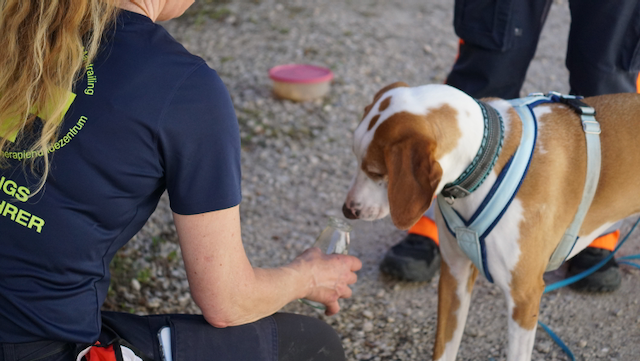
The most spectacular use of these substances takes place outside the laboratory: in civilian cadaver search operations. Whilst a human perceives only the ‘smell of death’ as indefinable, specially trained Human Remains Detection (HRD) dogs are able to identify the specific scent mixture of putrescine, cadaverine and other fatty acids.
Scientific research has demonstrated that these amines are indeed detectable in the soil above decomposing bodies.
Studies show that both putrescine and cadaverine occur in significant concentrations in the ‘odour trail’ of corpses.
Interestingly, dog handlers often resort to ‘pseudo-corpses’ (artificial body dummies) to train the dogs without having to use real human remains. However, analyses of such training aids have revealed that their composition varies greatly. Whilst some commercially available aids contain high concentrations of putrescine (up to 1440 mg/mL) and cadaverine (up to 780 mg/mL), others contain no detectable amines. This raises the ethical and practical question: Are dogs trained solely on synthetic putrescine truly sensitive to the complex chemical mixture of a real corpse?
Beyond the search: The invisible danger
Although they serve a useful purpose, putrescine and cadaverine are not harmless. They are biological markers of decay, and their presence in food is a sign of poor quality. In high concentrations, such as those found in spoiled fish or mature cheese, they exert a cytotoxic effect. Studies on intestinal cells show that they trigger necrosis (cell tissue death) without undergoing programmed cell death (apoptosis). Furthermore, they can amplify the toxic effect of histamine by blocking the enzymes responsible for its breakdown in the gut.
Conclusion
Putrescine and cadaverine are chemical Janus figures. On the one hand, they act as messengers of death, whose synthesis and handling require the utmost chemical precision to lay the invisible trail for the sleuths. On the other hand, they are biological warning substances that indicate spoilage and health hazards. Their investigation links the silence of decay with the high-tech world of analytical chemistry and the innate ability of man’s best friend to sniff out the truth.