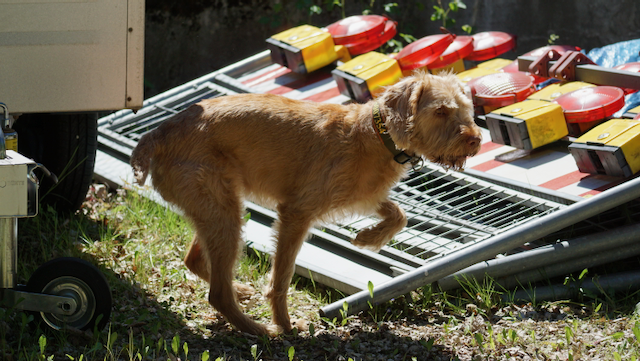
Civilian body recovery in the event of a disaster: Between humanity and professional detachment
When natural disasters strike or technical catastrophes occur, public attention is usually focused on rescuing survivors. Less visible, but equally significant, is the dignified recovery of the deceased. Civilian search and recovery operations as part of disaster relief are a demanding task that combines technical skill, psychological resilience and a deep sense of ethics. In this field, specially trained cadaver dogs play an irreplaceable role.
The distinctive nature of civilian cadaver search
Unlike in forensic science or police investigations, civilian disaster relief is not about solving crimes, but about the systematic search for the deceased following natural disasters, major accidents such as train derailments or building collapses, as well as floods or fires. The challenge lies in the often unstructured environment, the size of the search area and the need to work quickly yet thoroughly. For the bereaved, every person recovered represents a step towards certainty and thus towards the grieving process. For the rescuers, it is emotionally demanding but necessary work, caught between the conflicting demands of efficiency and respect.
Training cadaver dogs: A highly specialised process
The training of a cadaver detection dog differs fundamentally from that of a rescue dog. Whilst the latter is trained to detect the scent of living beings, the cadaver detection dog must recognise the volatile organic compounds produced during the decomposition of human tissue. These include putrescine, cadaverine and other biogenic amines. Training begins with positively conditioned scent sources: synthetic training aids, and later real tissue samples obtained in an ethically sound manner.
A trained cadaver detection dog can locate the scent of a body through several metres of ground cover, beneath layers of rubble, in stagnant water or in airy cavities. The dogs do not work visually, but purely by scent – they literally sense what the human eye cannot see. Training lasts between 18 and 24 months, depending on the breed and aptitude, and also covers distinguishing between human and animal carcasses, as well as maintaining focus in the face of distractions.
Deployment scenarios and working with humans
In the event of a disaster, the dog handler works as a team with their animal. Whilst the dog takes over the search for traces, the handler observes changes in the dog’s behaviour: increased sniffing, a sudden pause, a cautious retreat or the typical ‘indication’ by lying down or barking. The handler must be able to interpret their dog’s signals precisely – false alarms are rare but possible, for example in the presence of strong decomposing odours from animal carcasses.
The practical search follows a grid system. The team systematically combs through the disaster area, often for hours on end. In the event of building collapses, the dogs are guided over piles of rubble using special harnesses. Following a flood disaster, they can search riverbanks from boats. The physical strain on both dog and handler is enormous – they often work in heat, cold, wet conditions and in dangerous environments.
Psychological and ethical dimensions
The deployment of cadaver dogs is not merely a technical matter, but also a deeply human one. The dogs themselves seem to realise that they are no longer searching for the living. Many dog handlers report a noticeable change in their animals’ behaviour when a body is found: less excited barking, more of a quiet stillness. Whether this is actually an understanding of death or merely a reaction to the lack of response from the ‘toy’ – the experience remains moving.
For the dog handlers themselves, the work is a psychological challenge. They are regularly confronted with death, with mutilated bodies, with the tragedy of children and the elderly. Reputable aid organisations therefore offer mandatory debriefings and psychosocial support. At the same time, many dog handlers find their work deeply fulfilling: they give the dead back a face and the bereaved a final sense of certainty.
Limitations and future prospects
Despite their impressive abilities, cadaver dogs have limitations. Extreme heat or cold impair their sense of smell, and strong foreign odours such as chemicals or fire residues can complicate the search. Furthermore, dogs cannot work round the clock – their attention span is around 30 to 45 minutes before they need a break.
Researchers are therefore working on technical aids, such as electronic noses or ground-penetrating radar. Yet so far, no device has surpassed the sensitivity and, above all, the mobility and decision-making ability of a trained dog. The future lies in a hybrid solution: dogs as the first, rapid search component, supplemented by technical verification.
Final thought
Civilian cadaver search with dogs is a quiet, often overlooked service to others. In a world that likes to ignore death, these teams face the inconceivable – not out of a thirst for sensation, but out of a sense of duty and humanity. They remind us that disaster relief does not end when the last survivors have been rescued. It ends when every missing person has been found, when every family has certainty, when human dignity is preserved to the very end. The cadaver dog, this amazing creature with its sensitive nose and unwavering desire to please, is more than just a tool in this process. It is a silent witness to our responsibility towards the dead – and thus towards ourselves.